Containerization is a form of virtualization that runs applications in isolated user spaces known as containers. Notably, all these containers share the same underlying operating system. The container engine, pivotal in containerization technologies and container orchestration platforms, serves as the container runtime environment. It effectively manages the creation, deployment, and execution of containers.
Now let’s explore the magic of containerization. Imagine a container as a fully packaged and portable computing environment. It’s like a digital suitcase that holds everything an application needs to run —binaries, libraries, configuration files, dependencies —you name it. And the best part is that it’s all encapsulated and isolated within a container.
In olden days, running an application meant matching it with your machine’s operating system. For example, Windows software requires a Windows machine. However, containerization has rewritten this narrative. Now, it’s ancient history.
With containerization, you create a single software package, a container that gracefully runs on any device or operating system. What’s fascinating is that these containers seamlessly run while sharing the host operating system.
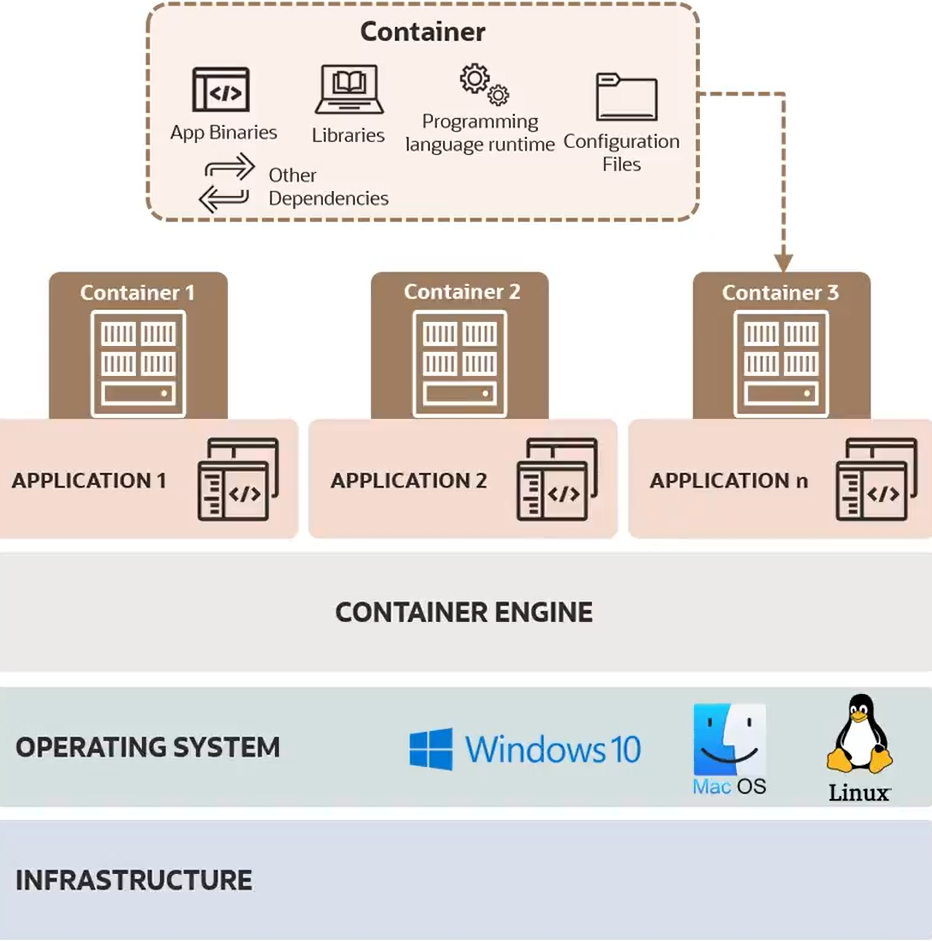
Now here’s the tricky part. The container engine is like a shadow abstracted from the host operating system with limited access to underlying resources. Think of it as a super lightweight virtual machine. The beauty of this is that the containerized application becomes a globetrotter, seamlessly running on bare metal, in VMs, or on cloud platforms without needing tweaks for each environment.
Let’s understand how it is different from virtualization. On one side, we have traditional virtualization. Picture this. It’s like having multiple houses on a single piece of land, and each house or virtual machine has its complete setup– wall, roofs, and utilities. This setup, while providing isolation, can be resource-intensive with each virtual machine carrying its entire operating system.
Now let’s shift gears to containerization, the modern-day superhero. Imagine a high-rise building where each floor represents a container. These containers share the same building or host operating system but have their private space or isolated user space. Here’s the magic. They are super lightweight, don’t carry extra baggage of a full operating system, and can swiftly move between different floors.
With containerization, there’s less startup overhead and no need to set up a separate guest OS for each application, since they all share the same OS kernel. Because of this high efficiency, containerization is commonly used to package the many individual microservices that make up modern applications.
Containerization unfolds a spectrum of benefits, delivering unparalleled portability as containers run uniformly across diverse platforms. This agility, fostered by open source container engines, empowers developers with cross-platform flexibility. The speed of containerized applications, known for their lightweight nature, reduces cost, boosts efficiency, and accelerates start times.
Fault isolation ensures robustness, allowing independent operations without affecting others. Efficiency thrives as containers share the OS kernel and reusable layers, optimizing server utilization. The ease of management is achieved through orchestration platforms like Kubernetes, automating essential tasks.
Security remains paramount as container isolation and defined permissions fortify the infrastructure against malicious threats. Containerization emerges not just as a technology but as a transformative force, redefining how we build, deploy, and manage applications in the digital landscape.


Recent Comments